


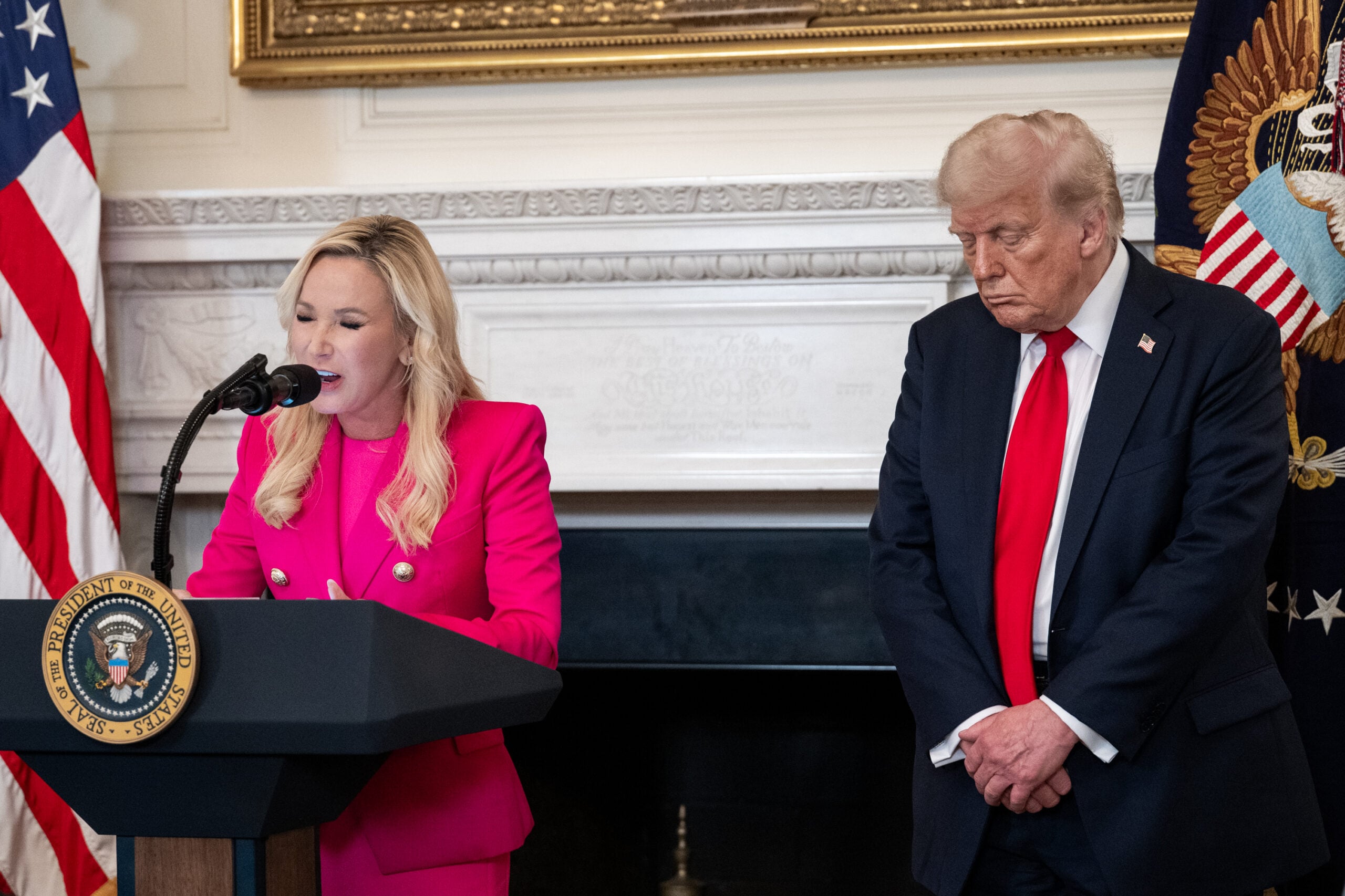
On February 7th, 2025, the Trump White House fact sheet proclaimed that, “President Donald J. Trump signed an Executive Order to establish the White House Faith Office.” The Faith Office, according to the statement, will “consult with experts within the faith community and make recommendations to the President regarding changes to policies, programs, and practices to better align with the American values,” and will also collaborate with the Attorney General to enforce “statutory protections for religious liberty.”
As a constitutional attorney, activist, and author who’s been fighting to keep church and state separate for fifteen years, I have some serious problems with this. Here are just a few.
First, in his announcement, Trump claimed this was a brand-new office, but it’s not. President George W. Bush created the White House Office of Faith-Based and Community Initiatives on January 29, 2001. He signed Executive Order 13199 in order to create this office to funnel taxpayer money to churches and religious organizations in violation of the Constitution. Oh, and to reward his political supporters.
We know this because Bush’s deputy director of that office, the late David Kuo, who was an evangelical Christian, left the office disenchanted and wrote a tell-all book entitled, “Tempting Faith: An Inside Story of Political Seduction.” Kuo tells of an office that was about rewarding political allies, not charity: “It couldn’t have been clearer that the White House needed the faith-based initiative because it had the potential to successfully evangelize more voters than any other.” They wanted a federal government office that was both religious and political, which is doubly problematic.
And the office did indeed evangelize voters. The office held events for embattled Republican candidates with faith leaders, and where such events were held, the candidates won 19 out of 20 races.
The veneer of legitimacy for the office was that it would fund charitable work. Groups would apply for grants, for public money, and then they would turn around and do good work with it. But, as is often the case when the government gets into the religion business, a strong undercurrent of personal bias and discrimination against non-Christians flowed through the office. Kuo quotes one grant officer who was in charge of deciding which groups would get federal money (which is to say, your taxpayer funds). The officer said, “When I saw one of those non-Christian groups in the set I was reviewing, I just stopped looking at them and gave them a zero.”

So the office that’s going to collaborate with the Attorney General on religious liberty has a history of discriminating in favor of Christians.
In short, Bush used this office to financially reward—not just to rally —his supporters and the organizations that got the vote out for him, mainly evangelical Christians. It was all a grift.
Over the years, especially under Obama and Biden, the office had broader goals. It was renamed the White House Office of Faith-based and Neighborhood Partnerships and, as the new name indicated, often partnered with churches as well as neighborhood organizations.
Trump has specifically renamed it the Faith Office, as if to wipe out the nonreligious and neighborhood aspects altogether. At least, that’s what the title of Trump’s executive order says. But if you read the order itself, it’s actually more expansive and includes some of that neighborhood language. So this seems more like a titular reward to his most fervent supporters, something that they can point to and say, “See! Look what he did for us!” Even though the change may not be so significant.
I know readers of this magazine are by now screaming at another big problem with this office: Giving government money to a religious organization is unconstitutional. It is a violation of the separation of church and state. Using the coercive taxing power of the government to take money out of my pocket and give it to a church I don’t attend violates my religious freedom. Government enforced tithing is a no-no in this country. It’s fundamentally un-American. Why isn’t everyone suing?
In the past, activists had successfully challenged this office at every turn because it was unconstitutionally doling out millions of dollars to churches and religious organizations—oftentimes to do religious work—in lawsuit after lawsuit. We were winning.
These groups stopped millions of dollars from unconstitutionally flowing to what amounted to state-sanctioned religion. So, what happened? Well, in 2007, the Supreme Court ruled that taxpayers have no legal right to challenge funds spent by the executive branch in almost every case, even if that expenditure violates the Constitution. The legal term of art they use here is “standing.” People have no standing to challenge these grants. This was early on in the Roberts Court and before it had been well and truly captured, but it was on its way. So if you’re wondering why there’s no lawsuit, it’s because the Roberts Court said nobody can sue.
Which brings us back to the grift. This is a particularly salient concern we should all have with Trump, especially given his history in business and politics. The grift in Trump 2.0 is already in overdrive. Wired magazine broke a story in March 2025 that found “people are paying millions to dine with Donald Trump at Mar-a-Lago. Business leaders are paying as much as $5 million to meet one-on-one with the president at his Florida compound… while others are paying $1 million apiece to dine with him in a group setting.”
There’s also some interesting data showing that this is one of Trump’s vulnerabilities with voters, and that connecting his fraud, deceit, and grift with this office, which is meant to be a sop to his evangelical base, may have some utility in the coming years.
The Faith Office was created to reward political allies in churches and funnel money their way. The people who worked in that office told us as much. Trump is a notorious grifter, and he has appointed Paula White—a prosperity gospel preacher who is an expert at enriching herself at the expense of her congregation—to run that office. As far as I’m concerned, the prosperity gospel is spiritual blackmail, a disgusting abuse that almost makes me wish there is a version of hell for the folks who preach it.
Now, I don’t know about you, but I have zero confidence that an office designed for grift will not be abused by Trump for his own financial gain and by Paula White for hers.
Some of White’s recent preaching has raised not just eyebrows but concern. After her appointment, White preached to her flock in a video that if you gave her a “Special Passover offering of $1,000 or more,” “God will assign an angel to you” and give you six other “supernatural blessings.” This raises so many questions: Did she do this on government time? With any government resources? Is she disseminating her prosperity gospel using the White House Faith Office? Is she, like DOGE, taking data from that office and using it to grow her reach and influence? Are angels really for sale?
Other than that last one, we don’t know the answers to these and many other questions, but we can certainly guess. (Reminder: Whistleblowers are protected under federal law).
The office was unconstitutional when Bush created it. It discriminated in favor of Christians; it waded into politics to help elect Bush’s cronies; it took money out of your pocket and gave it to churches. And now, Trump and White are almost certainly going to use it to get fatter off the “government teat,” even as they decry waste, fraud, and abuse across the government. Because for Trump and White, it’s all about the grift.