


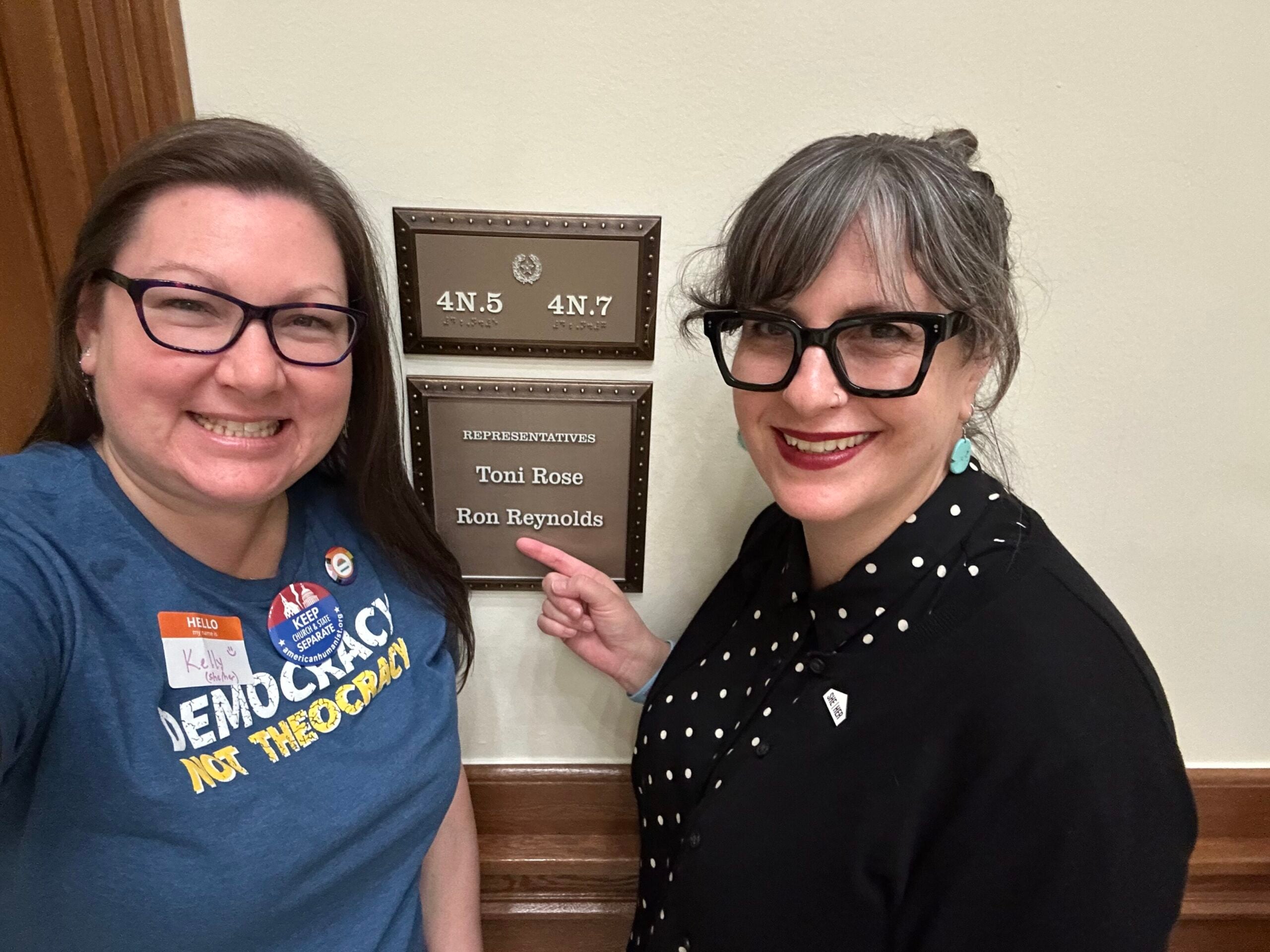
The first half of 2025 has been a very long ten years. From coordinated efforts to decimate or dismantle federal agencies to state lawmakers wielding the authority of their office to compel mass compliance with their personal religious beliefs, it often feels like the entire country must brace itself for the next disastrous news cycle. Although we are living in uncertain and unprecedented times, one fact remains: When atheists show up, we get things done.
Over the past six months, American Atheists has tracked more than 1,000 bills focused on inserting religion into public education, assaulting civil rights, overhauling government operations, and restricting health care access. This systematic monitoring served as the foundation for our direct policy engagement.
In committee hearings across the country, we advocated for the rights of all Americans. We contacted lawmakers hundreds of times to defend the separation of church and state and worked to ensure no person loses their fundamental rights. We mobilized our volunteers and worked with coalition partners to counter the wave of white Christian Nationalism surging in state governments.
Yet, even as we achieved significant victories in state legislatures, the past few months have also yielded troubling, even heartbreaking, setbacks. Legislators in many states continue to test the limits of how much they can restrict reproductive health care by criminalizing providing or facilitating abortions, and invoking civil rights language to justify eliminating personal autonomy.
Targeted Regulation of Abortion Providers (TRAP) laws remain a popular tactic to remove access to reproductive health care without needing to enact outright bans. Lawmakers have funneled millions of taxpayer dollars to unregulated faith-based organizations seeking to divert people experiencing unexpected pregnancies away from licensed medical providers—with the goal of delaying medical attention until continuing the pregnancy is the only option that remains.
There have been similar attacks in state legislatures against the LBGTQ+ community. States continue to restrict or ban gender-affirming care for trans youth, despite every major medical association warning these actions will cause irreparable harm to children. Kansas and Arkansas now prohibit foster care and adoption agencies from considering whether prospective parents will discriminate against a child placed with them based on that child’s sexual orientation or gender identity. And the most egregious erosion of human rights occurred in Iowa, which became the first state in the nation to remove gender identity and sexual orientation as protected classes within the Iowa Civil Rights Act.
Although these sobering setbacks must not be overlooked, it is important that we also celebrate some significant victories. Even in states with strong religious influence, access to birth control, mifepristone, and other reproductive medications remains secure after multiple ban attempts failed. So-called “heartbeat bills” stalled in almost every legislature where they appeared, and more than 90% of the efforts to grant zygotes, embryos, and fetuses full legal personhood were decisively defeated. A flurry of TRAP laws designed to impose excessive bureaucratic hurdles, stigmatize those seeking medical care, mandate fetal death certificates, and spread medical misinformation were successfully blocked—even in states where the political climate would suggest widespread support for these measures among lawmakers.
Across the country, we also scored decisive wins to preserve nonsectarian public education. Attempts to mandate school-sponsored Bible reading in Idaho and Mississippi never made it out of committee, and all measures seeking to teach intelligent design in science courses failed to progress beyond initial hearings. About 80% of proposals to ban diversity, equity, and inclusion in public education did not advance, including one bill in Texas intent on prohibiting “Neo-Marxist concepts” and subjects related to what the sponsor called the “Great Awokening.”
Although a couple of high-profile bills were signed into law, the vast majority of legislative attempts to erect Ten Commandments and “In God We Trust” displays in public schools were quashed. School privatization initiatives, including one proposal from Indiana to convert all public schools into charter schools, and so-called “parents’ rights” bills were rejected by the majority of states where they were introduced.
In fact, Washington became one of the first states in the country to push back against the parents’ rights legislative trend by enacting a law that affirms students’ rights supersede the demands of overbearing parents intent on controlling public education. Over 30 proposals to allow “school chaplains” into public schools were blocked, ensuring that public schools will continue to be a welcoming space for all students regardless of their background.
Finally, state-level health care regulations survived an orchestrated push to undermine patient protections and public safety. Colorado’s Transparency in HealthCare Coverage Act, drafted and championed by American Atheists just last year, was used to successfully defend against a sweeping “denial of care” bill that would have allowed doctors, hospitals, and insurers to refuse medical services based on religious belief. This is part of a broader pattern, where nearly 9 in 10 denial of care bills are rejected—even in states with a track record of enacting policies that favor religious belief over evidence-based health care. Much like with “denial of care” bills, lawmakers across the Deep South and the Northeast launched multiple campaigns to insert religious exemptions into vaccine requirements. Despite the introduction of dozens of such bills, fewer than 10% were enacted.
While it is easy to focus solely on the most headline-grabbing legislation, it is important to remember the vast majority of harmful bills never gain traction. Maintaining this strong shield against bad legislation requires one critical element: You.
Our data shows the most effective way to stop negative legislation in its tracks is simply to show up. When you testify at a committee hearing, call your lawmakers, sign petitions, or engage with American Atheists’ action alerts (atheists.org/ signup), you are adding to a collective movement that lets lawmakers know they will be held accountable for hurting constituents.
By refusing to remain silent, we can—and will— protect our communities and pave the way towards an equitable future for all.