


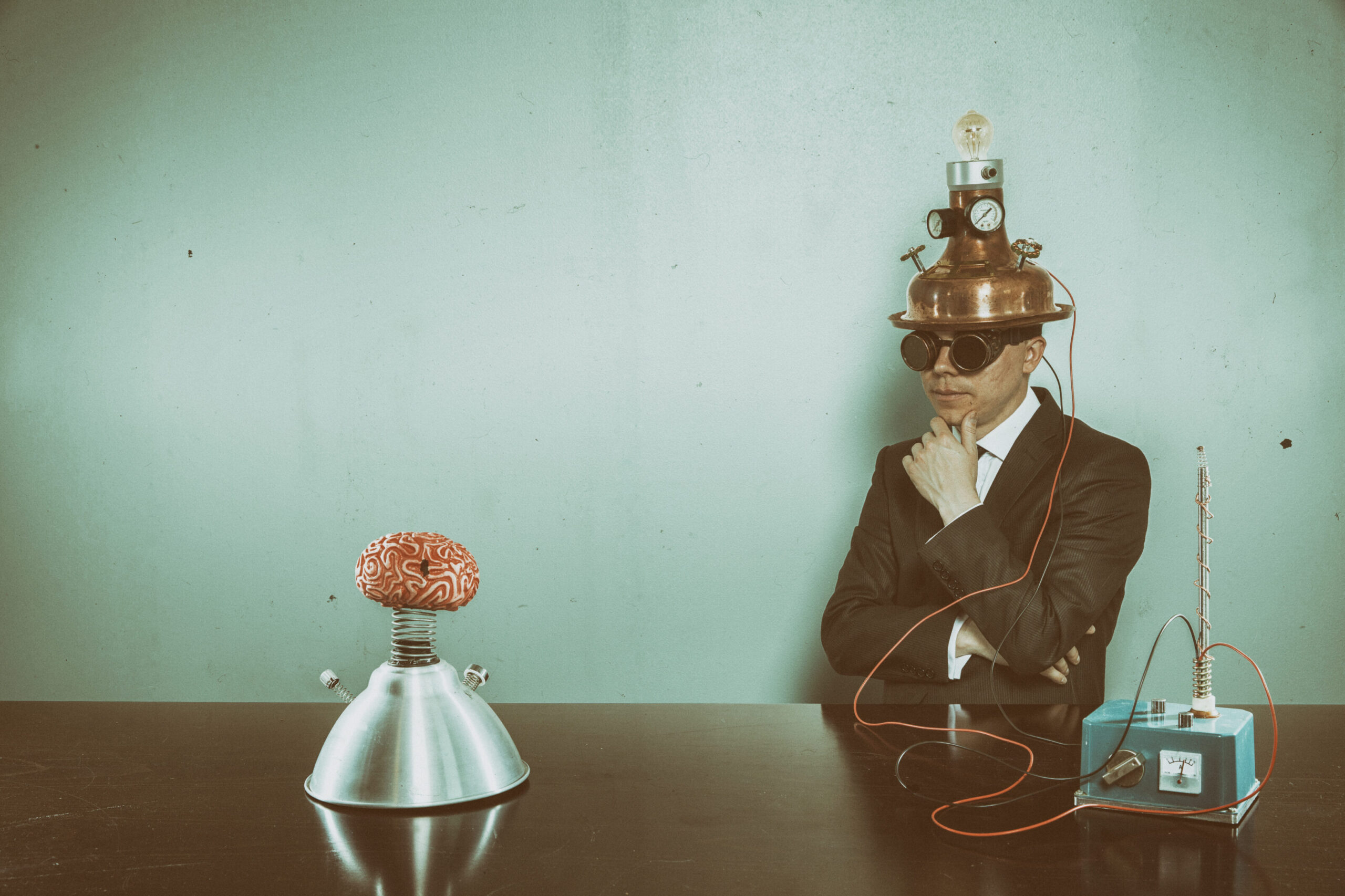
Looking for me? Check under my desk. I have been huddled here in a fetal position since early November, my mood pacing back and forth along a continuum marked Despair at one end, Anger at the other, and WTF in the middle.
But never mind why. Far be it from me to endanger the tax-exempt status of American Atheists by suggesting that my feelings have anything to do with recent election results. This is a work of fiction. Any inferences you may draw regarding my views of actual candidates living or dead are purely coincidental.
I am writing for the benefit of readers who, like me, find themselves marooned on the above-referenced continuum. I wish to submit for your consideration one of my favorite coping mechanisms: laughing.
You may well wonder what on earth there is to laugh about. These days, parody and satire are all but off the table. There is simply no out-absurding the likes of Jesus-endorsed sexual predators, “gazpacho police,” an anti-science cabinet, “they’re eating the pets,” a two-headed efficiency department, and whatever else is sure to hit the news by publication time. So off-the-rails is reality that Pulitzer Prize-winning cartoonist Robert Leighton caricatured himself learning that the “cartoon you came up with this morning just happened.”
Meanwhile, heightened consciousness has rightly nixed a good deal of so-called humor that was once de rigueur for stand-up comics and humor writers. This is thanks to a growing awareness of when (and how) it is (and isn’t) okay to venture into certain areas, and who has (and hasn’t) an arguable right to do so. It is best to remain within one’s lane and, even then, to proceed with caution. Unless, that is, you subscribe to what I call the Gervais-Maher Fallacy, defined as “whining about cancel culture when decent people choose not to consume insensitive material.” Or, unless you’re a politician who targets appearance, ethnicity, religion, orientation, and more, secure in the knowledge that crowds will vote their approval. Fair being fair, well-earned retorts will be met with righteous indignation and calls for civility.
Yet even with satire hobbled, even with dehumanizing humor dragged kicking and screaming out of fashion, there remain plenty of laugh opportunities. The social media brim with video clips of pratfalls, startled cats, and goofy dogs. Streaming services serve up comedies for every taste. There is no end of funny podcasts. Your bookstore has a humor section, and your daily paper has a comics page. You may have a comedy club nearby.
You will, of course, need to track down what is funny to you. That’s the funny thing about funny: there is no universal standard. Personal taste, culture, and experience all play a part in what one finds funny or not. Time and place are equally important. There is, as Erma Bombeck said, “a thin line that separates laughter and pain, comedy and tragedy, humor and hurt.”
Nor is a sense of humor risk-free. My friend Kyle, who has done standup comedy, dared wisecrack upon overhearing that a large, muscled man’s nickname was Twinkie. Pinning Kyle to the wall with an enormous fist, Twinkie growled, “You think Twinkie is a funny name?” Opting not to go with the more socially acceptable response of wetting himself and stammering a retraction, Kyle replied, “Not at all. Just ask my friends Cupcake and Ding Dong.” Violence might have ensued had Twinkie’s girlfriends— yes, plural—not intervened. When I asked Kyle why he’d damned the twinkpedoes and full-speeded ahead, he explained, “When was I ever going to have a setup like that again?”
Should you happen to number among those who fear we are headed for dark times, I hear you. All I can say is—if you’ll pardon the expression—thank god for dark humor. Poking fun at the decidedly unfunny can’t close a wound, but it can apply much-needed balm. Author and cartoonist Frank A. Clark had a point when he said, “The next best thing to solving a problem is finding some humor in it.”
One must tread carefully into dark humor, for it is rife with opportunities to land amiss. So it is that I apologize in advance should any of the following examples not sit well. Trigger warning: the first involves a stabbing, the second a burn victim, and the third dementia. I will take no offense should you skip the next three paragraphs.
In 1999, a man broke into the home of former Beatle George Harrison and stabbed him eight times. As Harrison was being carried out on a stretcher, he looked over at two staffers he’d just hired and said, “So what do you think of the job so far?” Harrison later cracked to Monty Python alum Eric Idle, “Why doesn’t this kind of thing happen to the Rolling Stones?”
I wasn’t present for the Harrison incident, but I was for the next two. Some years ago, my late wife and I joined a couple for dinner at a nice restaurant. One of them, a severe burn victim, inadvertently dipped his menu into a candle, setting it on fire. Cocking an eyebrow and cavalierly blowing out the flame, he sent us into uncomfortable hysterics with a line no one else would have dared utter: “Been there, done that.”
One of the saddest, most not-funny things I ever witnessed was dementia’s slow erasure of my mom’s memory. The last thing I thought Mom would do was joke about it. The doctor had just explained, gently as he could, what was going on. Mom gazed at the floor, letting the news sink in. A moment later, she looked up, flashed the doctor a mischievous smile, and said, “On a positive note, how soon will I forget my ex-husband?” The room cracked up, and all tension fled.
Now, I know better than to suggest that humor is a panacea. Should laughter elude, I wish to offer encouraging news in its place. In this and future issues of American Atheist, you will read of the organization’s positive, grassroots level attainments toward protecting human rights and maintaining religion-government separation. Their attainments are more numerous, frequent, and significant than you might think.
You will also find practical ways you can support those efforts. A number of them, I can personally attest, can be executed from a fetal position under a desk.