


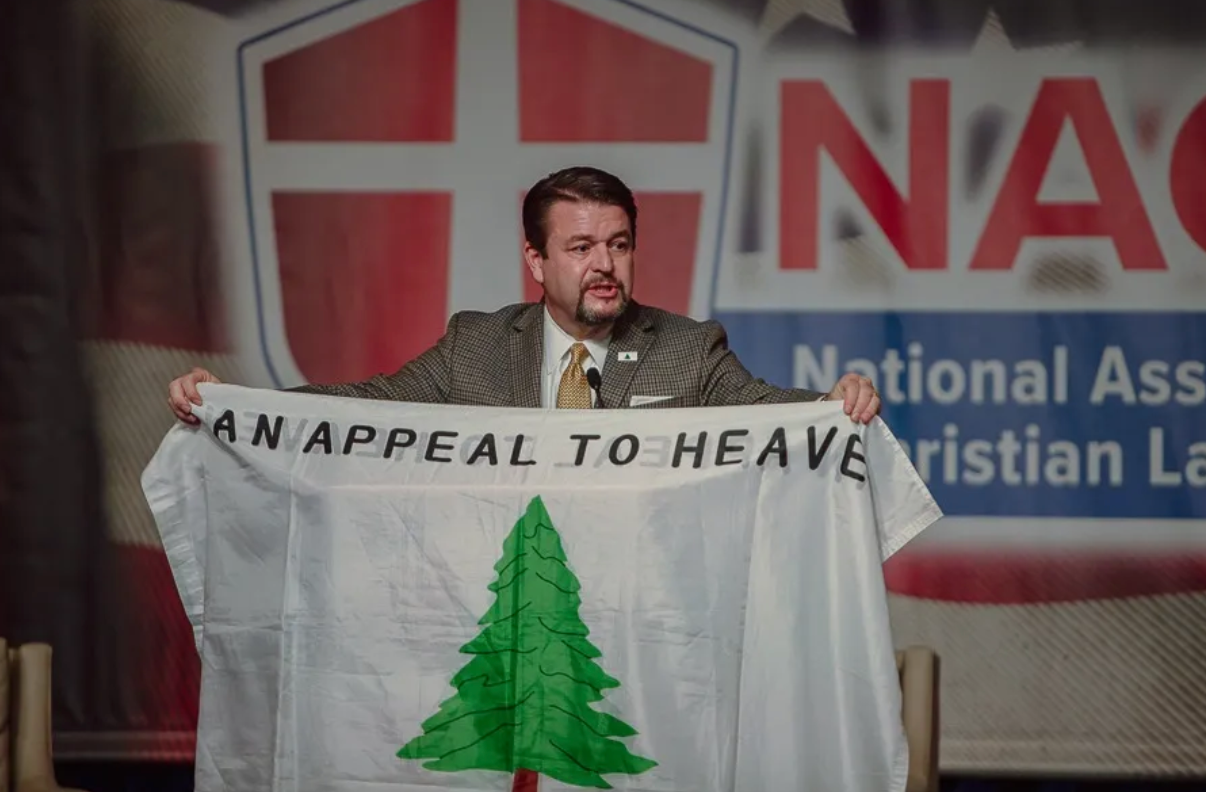
An historic legislative project of the Christian Right tried to fake its own death a few years ago. Faced with a rising tide of unwanted media coverage and effective responses by organizations that support constitutional democracy, Project Blitz scrubbed its name from its website and tried to pretend it never existed. The leader of Project Blitz in Ohio went so far as to lie to a reporter that it did not provide the model bill for the very legislation he had introduced. This was particularly remarkable since he was the Project Blitz state co-chair.
Although we succeeded in sending Project Blitz scurrying into dark corners, it lives on, albeit more discreetly. But the stories of a resounding victory not only live in history, but in the lessons learned by everyone who participated. This is our story.
In the spring of 2018, I was researching the Christian Right’s attacks on religious freedom and came across the 116-page strategy manual of Project Blitz, titled “Report and Analysis on Religious Freedom Measures Impacting Prayer and Faith in America.” It is the kind of document that one would think they would not want to be public, but there it was, hiding in plain sight.
As I read it, I felt like an archaeologist or scientist making an important discovery: You see it for what it is, and suddenly the world has changed. It struck me as so important that it required me to drop everything and write about it. When my article appeared in the online magazine Religion Dispatches, I emailed it to about 500 activists, journalists, and scholars with what came to be called the “Project Blitz playbook” attached. This quickly resulted in major reporting and opinion pieces in The New York Times, Religion News Service, The Guardian, Church & State magazine, and Salon and the active interest of leading religious, non-religious and civil rights organizations.
The Playbook
The playbook first was a remarkable distillation of lessons learned from legislative battles around the country. Out of this they had crafted 19 model bills and resolutions. These were accompanied by talking points and likely objections from the opposition and how to answer them. Second, it informed a national network of three dozen state legislative “prayer caucuses” modeled after the national Congressional Prayer Caucus. The lists of members of the prayer caucus chairs and members were posted on the website. Some states had dozens of members, others only a few.
The organizational sponsor was the then little-known Congressional Prayer Caucus Foundation (CPCF), headquartered in Chesapeake, Virginia, and led by the founder of the Congressional Prayer Caucus, former Rep. Randy Forbes (R-VA). The CPCF partnered in Project Blitz with the Pro-Family Legislative Network, led by activist David Barton of the Christian nationalist organization WallBuilders and the small National Legal Foundation.
The bills ranged from now well-known efforts to display the Ten Commandments and posters featuring the national motto “In God We Trust” in public schools, to anti-LGBTQ adoption bills, and versions of the Religious Freedom Restoration Act (RFRA) and First Amendment Defense Act (FADA) intended to invoke religious freedom against legal respect for marriage equality. Their main purpose is to offer “the collective wisdom and experience of individual legislators and legal teams,” and of “groups who have or will support such legislation.” It ceded the main anti-abortion agenda to Americans United for Life, which has long specialized in model state legislation.
The model bills are grouped according to the degree of opposition they anticipate. The general plan was to begin with the less controversial measures to get legislators comfortable with the subject matter and to seek small victories first. They felt that the path of least resistance was the bill requiring or allowing the display of “In God We Trust” in public schools and other public buildings. In fact, versions have been signed into law in a number of states including Florida, Alabama, Arkansas, Texas, and Tennessee. Although most of the legislators involved with Project Blitz bills are Republicans, the “In God We Trust” bills passed in Florida and Louisiana were originally sponsored by Democrats.
The plan has worked well, albeit not usually as sequentially as they envisioned. What’s more, the implementation of the Ten Commandments Display Act, which was signed into law in Louisiana, has been temporarily halted by a federal court in the face of a lawsuit by parents who believe that subjecting their children to this government endorsed message is a violation of their religious freedom. The case is expected to ultimately be decided by the Supreme Court.
But there is more to the playbook than the siloed, issue-focused pieces of legislation. Dr. David R. Brockman, a Nonresident Scholar at Rice University’s Baker Institute for Public Policy, originally told me that he sees Project Blitz “as a covert campaign for conservative Christian dominion over law and public policy.”
He added, “dominionism as I understand it seeks to align law and public policy with conservative Christian beliefs.” He further observed that the manual frames religious freedom resolutions (on heterosexual marriage, birth gender, and adoption) as intended to advance “biblical values.” However, citing the playbook, he said they also “caution policymakers not to frame legislation in biblical terms,” because “courts have frequently found such justifications ‘unreasonable’ or ‘irrational’ and not based on ‘reason’ or ‘science.’”
Further research showed that much of the Project Blitz network includes not only conventional evangelicals such as Southern Baptists, but also elements of the New Apostolic Reformation (NAR), a movement in Pentecostal and charismatic Christianity that seeks religious and political dominion in the United States and the world. Notably, the state director in Pennsylvania, Abby Abildness, is an important “apostle” in this movement. Many NAR leaders have long been close to Donald Trump, led evangelical support for his campaigns, and some participated in the January 6th insurrection.
The Response
Early on, Alison Gill of American Atheists, Elizabeth Reiner Platt of Columbia University Law School, and I staged webinars for large audiences on Zoom explaining Project Blitz and its significance. These webinars led to the formation of the Blitz Watch Coalition, which met monthly to update each other and plan activities regarding the continuing threat. The coalition comprised American Atheists, Political Research Associates (PRA), Americans United for Separation of Church and State, The Interfaith Alliance, the Secular Coalition for America, PFLAG, Religious Coalition for Reproductive Choice, SEICUS, Jews for a Secular Democracy, Freedom from Religion Foundation, American Humanist Association, National LGBTQ Taskforce, and Center for Freethought Equality.
Notable among all this was organizing dozens of national religious and civil rights organizations to issue a joint letter to thousands of state legislators opposing the anti-democratic, Christian nationalist intention behind Project Blitz.
In 2019, another, expanded issue of the Project Blitz playbook surfaced. I wrote about it again at Religion Dispatches. Now 146 pages, it featured more model bills and efforts to slicken their politics in order to inoculate themselves against critics. For example, they denied that they seek a theocracy and advised legislators to try not to be overtly Christian, present secular arguments for their legislation, and attempt to give the appearance that they respect religious pluralism. They didn’t explain how to do this with their model Ten Commandments Display Act. They did claim, however, that the model bills promote “religious tolerance” and “do not force any religion on anyone.” Still, the National Motto Display Act calls for the posting of the Christian religious slogan “In God We Trust” in public schools and buildings. They nevertheless claimed that the opponents of these exclusivist measures were “intolerant.” This is an odd argument coming from those who advance Christian supremacy by hook or by crook, and at every opportunity.
Therein is part of the value of studying these strategic documents and following those who are implementing it. Project Blitz and its leaders are a barrel of contradictions who have poor arguments against the authenticity of fairness and equality inherent in the idea of religious pluralism, and much else. They are such a striking example of the dominionist agenda, that they have been featured in such important recent books as The Power Worshippers: Inside the Dangerous Rise of Christian Nationalism by Katherine Stewart, and The Cult of Trump by Steven Hassan.
When USA Today followed up with a major exposé, and Salon and other media stayed on the case, the Congressional Prayer Caucus Foundation had had enough. They scrubbed every reference to Project Blitz, including the lists of members of the prayer caucuses. They pretended that Project Blitz did not exist.
Although CPCF no longer publishes the Project Blitz strategy manuals on their website (they are still available at blitzwatch.org) legislation based on their model bills is still introduced, and try as they might, they can’t help but continue to reveal much about themselves. Notably, they still publish on their website the names and contact information for their state directors under the rubric of the American Prayer Caucus Network. They also sometimes report on events sponsored by the prayer caucuses. They are hiding, but not very well.
Democratic Resilience
The story of Project Blitz is not only a revelation of the dominionist agenda, its constituent parts, strategy, and leaders. It is also a story of the resilience of democratic institutions and leaders in the face of movements seeking to undermine or end them.
The Blitz Watch Coalition continued to track and oppose legislation whose provenance lay with Project Blitz. Even when media attention faded, the bills became harder to track and to definitively source to Project Blitz, and our Coalition faded, American Atheists has continued to host the Blitz Watch website, and PRA has continued to produce the free, periodic newsletter Blitz Watch News to keep the thousands of subscribers up to date with the organizations, legislation, and leaders that comprise the ongoing if unnamed Project Blitz.
The ongoing exposure and response to Project Blitz has taught us and continues to remind us that it’s possible to stand up to and prevail against secretive, formidable anti-democratic movements and measures, and that our democratic institutions are more resilient than they may sometimes seem. We are also reminded the sunlight of journalism remains the best disinfectant in a democracy.
All that we have learned is too valuable to be lost in the fog of the culture war. That’s why we want to build on that knowledge and find fresh ways to use it in this new political era. That’s what we will be doing when PRC and American Atheists renovate and relaunch the website and newsletter in 2025.