


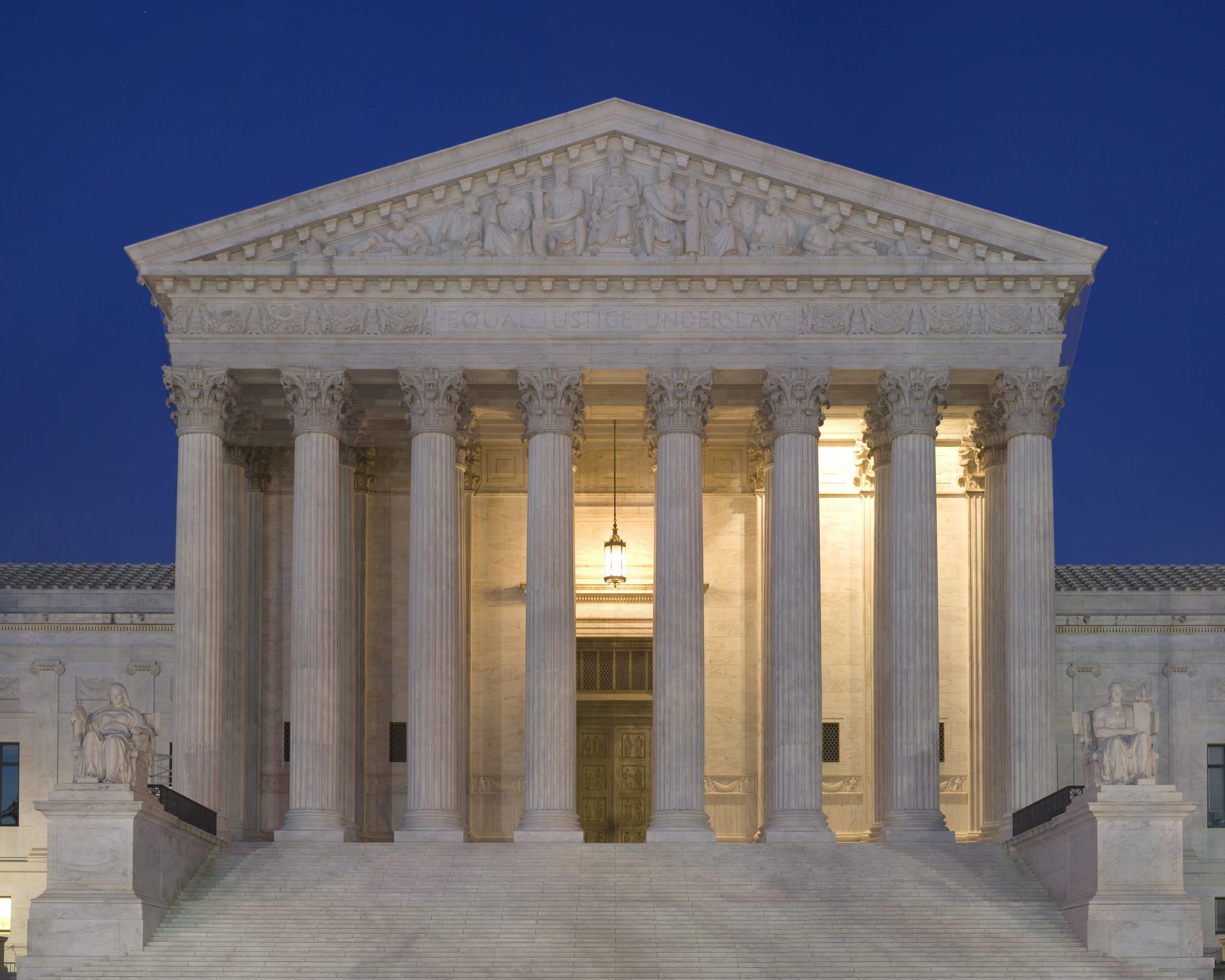
Two years ago, the Supreme Court did away with the Lemon test for deciding Establishment Clause cases. In its place, Justice Gorsuch’s majority opinion announced that courts must instead examine history and tradition in order to determine whether the government’s actions are impermissibly “respecting an establishment of religion,” which the First Amendment prohibits.
Unfortunately, the Court provided no guidance for how this examination of “historical practices and understandings” should be conducted. History is, of course, an entirely different field from law and, absent any guidance, judges in lower courts run the risk of doing history very poorly.
In order to encourage judges to examine historical evidence in a sound, objective way, American Atheists partnered with historians to draft an amicus brief to guide judges suddenly facing the task of discerning and applying history in addition to the law.
The Lemon Test
Named for the 1971 case that summarized the Court’s default approach to Establishment Clause cases, Lemon v. Kurzman, the Lemon test stated that the government created an unconstitutional establishment of religion if it either (a) acted without a secular purpose, (b) had the primary or principal effect of advancing or inhibiting religion, or (c) created an excessive entanglement between the government and religion. It was by no means a perfect test, but it served us well for decades, until the Supreme Court majority shifted to a more hard-line religious mindset.
The Court began carving out exceptions when the test produced results it didn’t like. Prayers at the start of legislative sessions, for example, have no legitimate secular purpose and have the principal effect of advancing religion, yet the Court concluded that the practice was fine, since the first Congress had started the practice. And they obviously couldn’t have acted inconsistently with the Bill of Rights they were busy passing. Inconceivable! The Establishment Clause must not be meant to encompass that practice, or so the Court said. And so in that context, long-standing tradition overrode the Lemon test.
This exception to the Lemon test, and others like it, slowly compounded until, in the 2022 case Kennedy v. Bremerton, the Court declared that the exceptions had fully swallowed the rule. The Lemon test was no more. It was too vague, the Court said, too riddled with exceptions, and led to conflicting results. In its place, the Court announced that, unless there is already a case directly addressing the underlying controversy, the judges’ interpretation of the Establishment Clause should be guided “by ‘reference to historical practices and understandings.’” This approach, according to the Supreme Court, avoids the pitfalls of the Lemon test.
History and Tradition
Judges are not historians. Neither are attorneys. And although the Supreme Court did away with the Lemon test in Kennedy v. Bremerton, it did not guide judges in lower courts as to how to glean the “historical practices and understandings” they are now required to rely on. Some have leapt on this oversight by the Supreme Court as an opportunity to peddle a skewed version of history, relying on ideologically curated databases and a form of analysis called “corpus linguistics,” as well as generative AI, in the hopes of predetermining the result whenever this history-and-tradition analysis is applied.
Luckily, this biased application of history can easily be avoided, and the Supreme Court has already laid out how. It has been applying history-and-tradition analysis in another context: gun rights. From the Supreme Court’s approach to recent Second Amendment cases, several key aspects of the history-and-tradition analysis are clear. First, and most importantly, when there is already case law addressing the issue, there’s no need to do historical analysis.
Existing Establishment Clause case law carries the same weight today as it did before the Court announced the Kennedy decision.
Second, and nearly as important, the government defendants have the burden of proof. It is up to the government to show that its actions are consistent with longstanding and widespread history and tradition. It is not enough for the government to point to occasional isolated incidents. The government’s historical evidence must be of an “unambiguous and unbroken” nature, not a few outliers. If the government fails to provide such evidence, it is not the responsibility of the judge to independently seek their own confirming evidence. Nor is it the responsibility of the plaintiffs seeking to enforce their rights to prove the negative: that there are no analogous examples from history. The government must support its actions; and if it fails, it fails. History’s silence on a particular question does not give the government carte blanche to impose religion on the people. In fact, history’s silence dooms such acts.
Third, any examples of history and tradition the government points to in support of its actions must be from the appropriate era of history. Examples from the colonies, before the Constitution was ratified, carry no weight. Unlike the Second Amendment context, where pre-Revolution practices can contribute to the understanding of a right that the people already possessed under colonial legal principles, colonial practices are relevant to the Establishment Clause only insofar as they may illustrate practices from which the fledgling United States sought to depart. The reason for this difference is simple: the Establishment Clause “lay[ed] down a novel principle,” in contrast to the Second Amendment, which solidified long-standing rights.
In other words, while accepted practices that predated the adoption of the Second Amendment can be used to infer that similar practices today are valid, the same cannot be said for the Establishment Clause. The Establishment Clause was a novel development in the law, enacted in direct response to, and in departure from, the status quo under English rule and the colonial governments.
The Establishment Clause “broke new constitutional ground in the protection it sought to afford to freedom of religion, speech, press, petition and assembly.” As the Supreme Court noted in the 1947 decision, Everson v. Board of Education, the practices of established churches “shock[ed] the freedom-loving colonials into a feeling of abhorrence” and “aroused their indignation.”
The colonists’ objections to practices such as taxing the public to pay government-approved ministers and build and maintain churches, compelling tithes and church attendance, and other hallmarks of established churches “found expression in the First Amendment.”
The history-and-tradition test is deeply flawed. But it is the test the Supreme Court has saddled us with, and it is unlikely to change anytime soon. Through this amicus project, we will speak directly to the judges handling Establishment Clause cases. Our guidance, if accepted, will help ensure the new test at least reaches consistent results and doesn’t merely reflect the whims of the individual judges deciding cases that will impact our fundamental right to be free of government-imposed religion.